Decentralized mesh Wi-Fi network and digital platform enabling affordable connectivity and digital services for underserved rural communities.
Brother Industry; Honda.
According to the International Telecommunication Union (ITU), more than 700 million people in Sub-Saharan Africa remain without reliable internet access, particularly in rural areas where traditional connectivity infrastructure is costly and difficult to deploy. Limited connectivity restricts access to essential services such as education, financial systems, health information and market opportunities, contributing to persistent economic exclusion and reinforcing cycles of poverty. Rural populations often remain digitally invisible due to geographic isolation and low commercial incentives for telecommunications investment. Without affordable and locally relevant digital infrastructure, communities face structural barriers to participation in the digital economy and broader social development.
d.CONNECT is a proprietary technology from Japanese company Dots for Inc. that provides decentralized, low-cost mesh Wi-Fi networks combined with a digital services platform. The solution is designed specifically for underserved rural environments in Africa. Using proprietary hardware that requires minimal maintenance, the solution creates village-wide connectivity through solar-powered infrastructure that enables both local intranet access and affordable global connectivity. Beyond connectivity, the platform supports access to digital banking, health information, education resources and e-commerce services optimized for low-bandwidth environments. The solution integrates connectivity with digital services and local capacity development, enabling communities to access and benefit from digital opportunities while maintaining sustainable local operations.
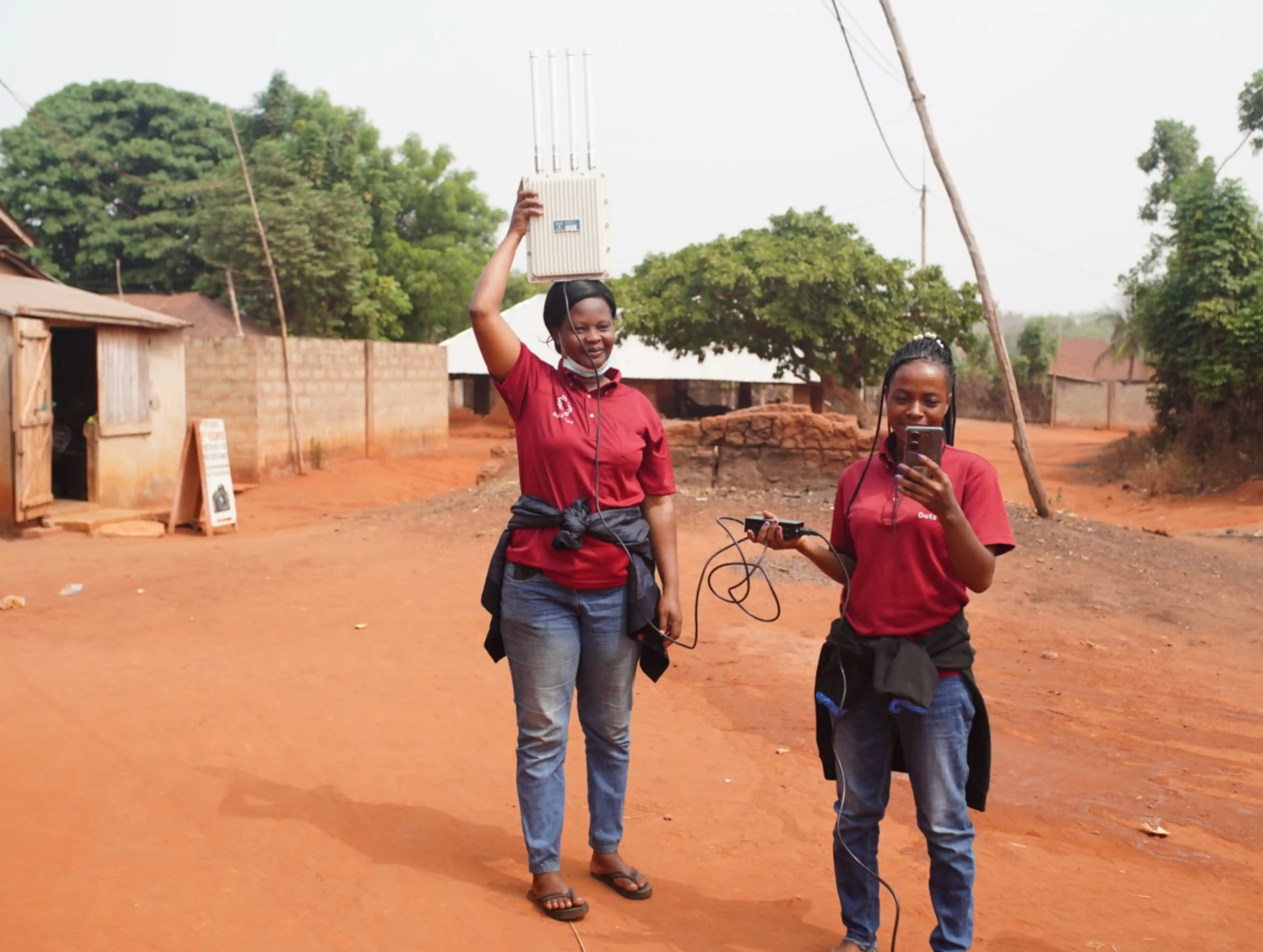
The solution targets rural communities that lack access to conventional internet infrastructure, enabling connectivity in locations where traditional telecom models are not economically viable. By relying on decentralized mesh networks and solar power, d.CONNECT drastically reduces infrastructure costs and ensures accessibility in low-resource settings. The platform is designed for low-bandwidth environments and supports locally relevant services, allowing communities with limited digital literacy or device access to participate. Local entrepreneurs are trained to manage operations, ensuring community ownership and long-term sustainability while expanding economic participation for vulnerable populations.
d.CONNECT has rapidly expanded across West Africa and is currently operating in over 600 villages in Benin and Senegal. It has enabled more than 800,000 people to access online services, and the service is expanding by 10 percent each month. The platform supports over 8,000 active paying customers who use financial and digital services through the network. Its primary measurable outcome is improved community livelihoods. The initiative has created over 400 local jobs and generated income growth for individuals of up to one hundred times their previous earnings, through digital work programmes. The solution has also demonstrated strong operational sustainability, maintaining a strong growth rate of 45.2 percent every quarter over the past three years.
Field implementation highlights the platform’s impact at the individual level. In rural Benin, an apprentice dressmaker accessed online training and used a Buy Now, Pay Later (BNPL) financing service to purchase equipment, enabling her to establish an independent business and earn 15,000–20,000 FCFA per month, or around US$25-35. Scalability has also been proven through a franchise pilot in Zambia, where a local partner independently deployed the Smart Village model, with residents using digital services within hours of installation.
The solution aims to scale the Smart Village model to 5,000 villages across West Africa by 2028. Planned geographic expansion includes neighbouring countries such as Côte d’Ivoire and Togo. The development roadmap includes deepening fintech, edtech and agritech services to strengthen human security for rural populations.