An AI and satellite data platform that forecasts hidden water infrastructure risks and enables proactive, sustainable water management.
Japan Aerospace Exploration Agency (JAXA); Ministry of Health, Labour and Welfare (Japan); Aisin Corporation; Premier Water Services (Malaysia); Universiti Sains Malaysia; Swach Environment (India); UNDP Accelerator Lab
Water infrastructure systems worldwide are aging, leading to significant water loss through undetected leaks. Traditional detection methods are reactive and typically identify problems only after visible damage occurs, resulting in wasted water, costly emergency repairs, and infrastructure deterioration. Water utilities and municipalities—often operating under limited budgets—struggle to monitor extensive underground pipe networks efficiently, while communities face increasing water scarcity and environmental impacts caused by preventable losses.
These challenges disproportionately affect resource-constrained municipalities and regions where deploying extensive ground-based monitoring systems is costly or impractical. Without forecasting tools, utilities must rely on inefficient inspections, limiting their ability to prioritize maintenance and manage infrastructure sustainably.
KnoWaterleak transforms water infrastructure management from reactive repair to predictive prevention by combining satellite observations, infrastructure data and AI-powered analytics. The platform integrates surface temperature data, ground deformation measurements, pipe characteristics and maintenance records to identify hidden risks before leaks occur.
Unlike traditional leak detection systems that rely on single data sources or physical inspections, KnoWaterleak uses multi-source data fusion and a proprietary five-level risk evaluation system to prioritize maintenance actions. Built on the Tenchijin COMPASS platform from space-tech innovator Tenchijin, the solution supports long-term infrastructure planning, reduces operational costs and improves water sustainability through data-driven decision-making.
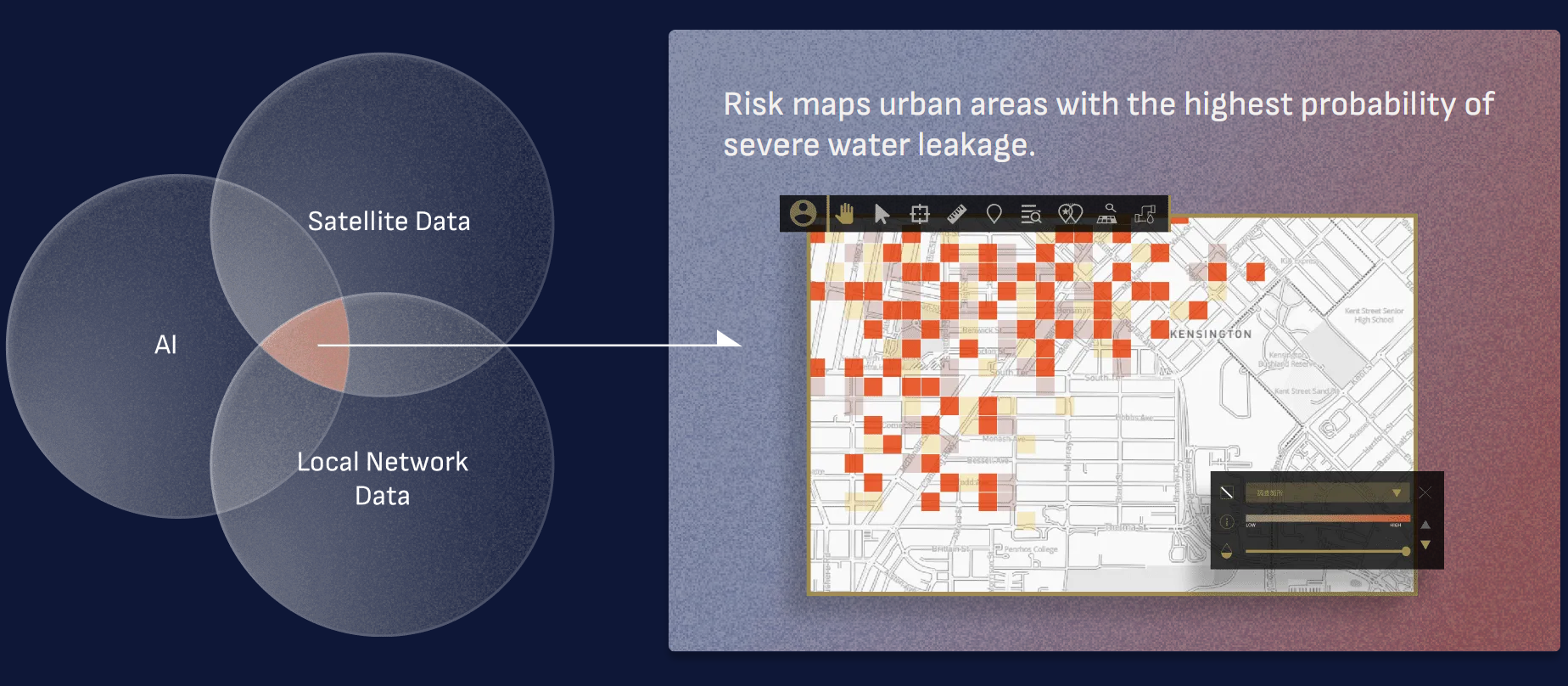
KnoWaterleak enables advanced infrastructure monitoring without requiring expensive ground sensors or extensive technical capacity. By leveraging satellite data, the platform allows municipalities to assess underground infrastructure remotely and prioritize maintenance based on risk rather than costly trial-and-error inspections. This approach helps utilities maximize limited budgets, prevent costly failures, and reduce water loss, supporting communities facing water scarcity.
KnoWaterleak has demonstrated strong scalability and real-world adoption across diverse infrastructure contexts. The solution has been deployed in over 60 municipalities and implemented across four countries in Asia and Europe, validating its effectiveness across different geographic and operational environments. To date, the platform has analysed more than 95,000 km of water pipeline networks, establishing extensive experience in large-scale infrastructure risk assessment and predictive maintenance planning.
At the local level, measurable operational improvements have been achieved. In a municipality of 100,000–200,000 residents, leak detection efficiency increased sixfold, rising from 0.7 leaks detected per 10 km using traditional methods to 4.2 leaks detected per 10 km when combined with KnoWaterleak. Investigation costs were reduced by 79 percent, and predictive risk assessment proved highly effective: 40 percent of the detected leaks were found in the 20 percent of the network defined as high-risk. These results demonstrate the effectiveness of targeted, data-driven maintenance prioritization.
Tenchijin is planning a phased global expansion aligned with infrastructure maturity and market needs. Initial growth focuses on European markets, particularly France and Germany, positioning KnoWaterleak as a decision-support platform for infrastructure renewal planning. Medium-term development will strengthen integration with existing water management systems and enable continuous monitoring capabilities. Longer-term expansion will incorporate financial risk metrics such as expected loss analysis and investment modeling.