An AI-informed policing system that forecasts high-risk crime locations and optimizes patrol and security resource deployment.
New Energy and Industrial Technology Development Organization (NEDO), Japan; National Institute of Information and Communications Technology (NICT), Japan; Ministry of Economy, Trade and Industry, Japan; municipal governments and local police departments in Japan.
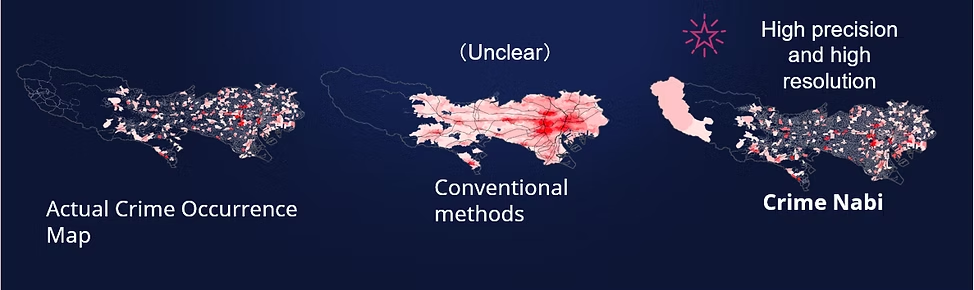
Many cities around the world face increasing public safety pressures while operating with limited law enforcement resources. Rising crime levels, workforce shortages and evolving crime patterns require authorities to move beyond reactive approaches. In Japan, over 700,000 criminal offenses were recorded in 2023, a figure exacerbated by reduced policing capacity. Similar challenges exist in cities such as Belo Horizonte, Brazil, where crime has strained local security systems and affected economic activity. Across both high- and middle-income contexts, traditional policing methods often lack the precision needed to allocate resources effectively, highlighting the need for innovative tools that inform proactive and efficient crime prevention strategies.
Crime Nabi is an AI-based policing system that analyses large and diverse datasets to forecast where and when crimes are likely to occur. It integrates historical crime records, demographic data, building attributes, satellite imagery, environmental conditions and contextual indicators to generate high-resolution spatial risk assessments. Crime Nabi supports crime prevention through a multi-product approach with products that include organizational planning and management tools, the Crime Nabi mobile/web, patrol plan, patrol routing API, risk area analysis, a hotspot policing tool, security camera monitoring operations planning, and camera surveillance planning functionalities.
Unlike conventional models, Crime Nabi uses proprietary data compression technology to enable fast computation and scalable deployment, including potential edge computing applications. The system forecasts crime hotspots using aggregated activity data rather than predicting individual behavior and is designed for responsible use with safeguards to reduce risks of bias, and discrimination, including data anonymization, oversight, and contextual interpretation of results. The system not only forecasts crime hotspots but also generates optimized patrol routes and security deployment plans and quantitatively evaluates the effectiveness of interventions using real activity data, supporting accountable and evidence-based public safety operations.
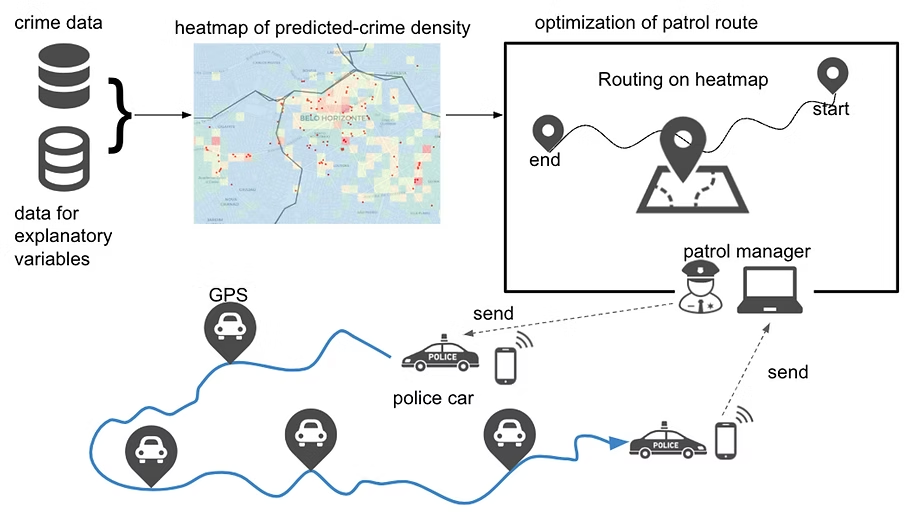
Crime Nabi supports more equitable public safety by enabling efficient use of limited security resources in high-density urban areas and under-resourced environments. Through transfer learning technology, the system can generate crime risk assessments in areas without comprehensive historical crime data, which is particularly relevant for lower-capacity municipalities or emerging urban centres.
Crime Nabi has demonstrated measurable impact in improving crime prevention outcomes across multiple contexts. In Belo Horizonte, Brazil, deployment of Crime Nabi-supported patrols resulted in a 69 percent reduction in crime in targeted areas. A citywide comparison showed that areas using the system achieved approximately twice the crime deterrence effect compared to areas not using it, confirming its effectiveness in supporting proactive and resource-efficient policing.
Verification studies in Tokyo, Nagoya City, and Adachi Ward further showed over 1.5 times higher effectiveness compared to conventional crime prevention models. The system has also improved patrol route optimization during major public events, enabling more efficient personnel deployment and strengthening preventive security measures in high-density urban settings.
Crime Nabi is expected to further expand both geographically and technically. Future development includes scaling edge computing capabilities to enable deployment on mobile devices, drones and robotic security systems. This would allow real-time, on-site risk analytics without reliance on centralized high-performance infrastructure.