Scalable, non-lethal AI-powered early-warning system for global bird-related crop damage.
Ministry of Lands, Agriculture, Fisheries, Water and Rural Development in Zimbabwe; Zimbabwe Wildlife and Management Authority (ZimParks); Government of Japan; Embassy of Japan in Zimbabwe; UNDP Zimbabwe.
Bird-related crop damage is an under-addressed but severe global threat to food security and smallholder livelihoods. In high-risk regions, mass-flocking species such as the Quelea bird in Southern Africa cause catastrophic crop losses — estimated at 40 percent of millet and sorghum and up to 95 percent of wheat in Zimbabwe for fields without pest control. For smallholder families, this can mean losing an entire year's food supply and income. Conventional responses rely on highly toxic pesticides such as Fenthion, which create serious environmental and public health risks. At the same time, governments and agricultural extension services lack real-time data on bird movements and damage hotspots and this prevents coordinated, efficient and timely responses. The result is a reactive, fragmented system that fails both farmers and ecosystems.
BirdShield AI is a modular, AI-powered drone and early-warning system that provides a non-lethal, coordinated defense against bird-related crop damage. It shifts the approach from reactive, farm-level scaring to proactive, systemic risk management.
The system combines real-time farmer reporting, AI monitoring, and targeted drone deployment. It creates live ‘red-zone’ risk maps, allowing drones to be deployed solely to high-risk areas where predator sounds are used to safely deter birds. Unlike toxic pesticide spraying or labour-intensive manual scaring, BirdShield AI offers an environmentally safe, cost-effective, species-agnostic and scalable alternative. It also enables government agencies and UNDP Country Offices to coordinate responses at regional and national levels using centralized, actionable data.
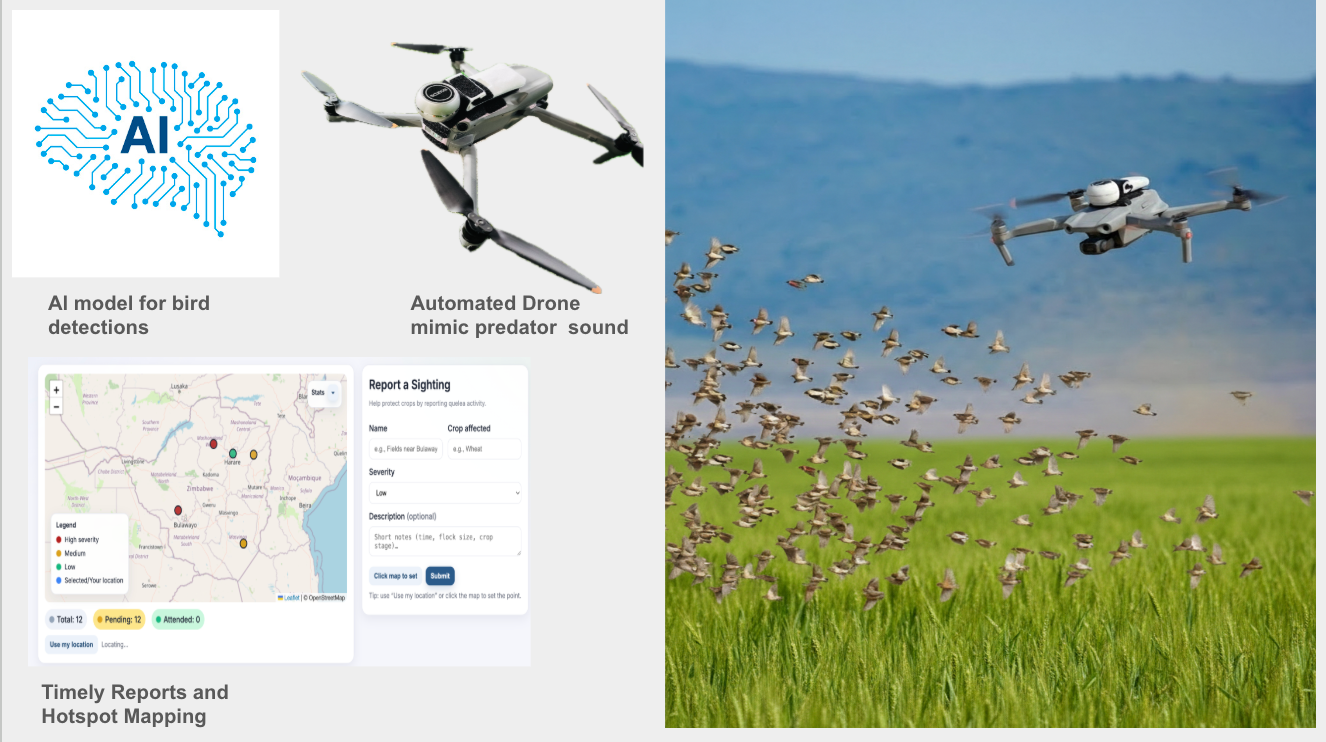
BirdShield AI is specifically designed for low-connectivity rural environments. Farmers and extension officers report bird sightings through simple, low-bandwidth web or mobile interfaces that function on basic smartphones. The system does not require advanced digital literacy, ensuring accessibility for smallholder communities.
The drone infrastructure is supported by solar-powered charging systems, allowing operation in off-grid regions with unreliable electricity. Local operators are trained to manage deployment and maintenance, fostering local technical capacity and reducing dependence on external expertise. This ensures that vulnerable rural populations are not just beneficiaries of the technology but active participants in its operation and long-term sustainability.
Since implementation, the social impact of BirdShield AI has been immediate and quantifiable. During a two-week field demonstration, community interviews and field observations confirmed that farming households reclaimed up to four hours per day previously spent on manual bird scaring, equivalent to 56 hours per household over the demonstration period. This time was reallocated to income-generating activities for women and to schoolwork for children, directly contributing to SDG 4 (Quality education) and SDG 5 (Gender equality). Beyond Zimbabwe, the system was validated and successfully applied to another geographic context in Japan, for duck deterrence. This confirms the system’s modular, species-agnostic design and readiness for multi-country scale.
BirdShield AI’s expansion strategy focuses on replication through institutional partnerships rather than one-off pilots. The immediate next phase includes scaling to additional high-risk regions within Zimbabwe in coordination with UNDP and government partners. The system can be adapted to different bird species, crops or regulatory environments with minimal customization.
Long-term expansion aims at regional and cross-country deployment through partnerships with UNDP Country Offices and national governments. By training local operators and integrating into existing agricultural response systems, BirdShield AI is positioned to become a sustainable, institutionalized component of national food security strategies worldwide.